 Vessel
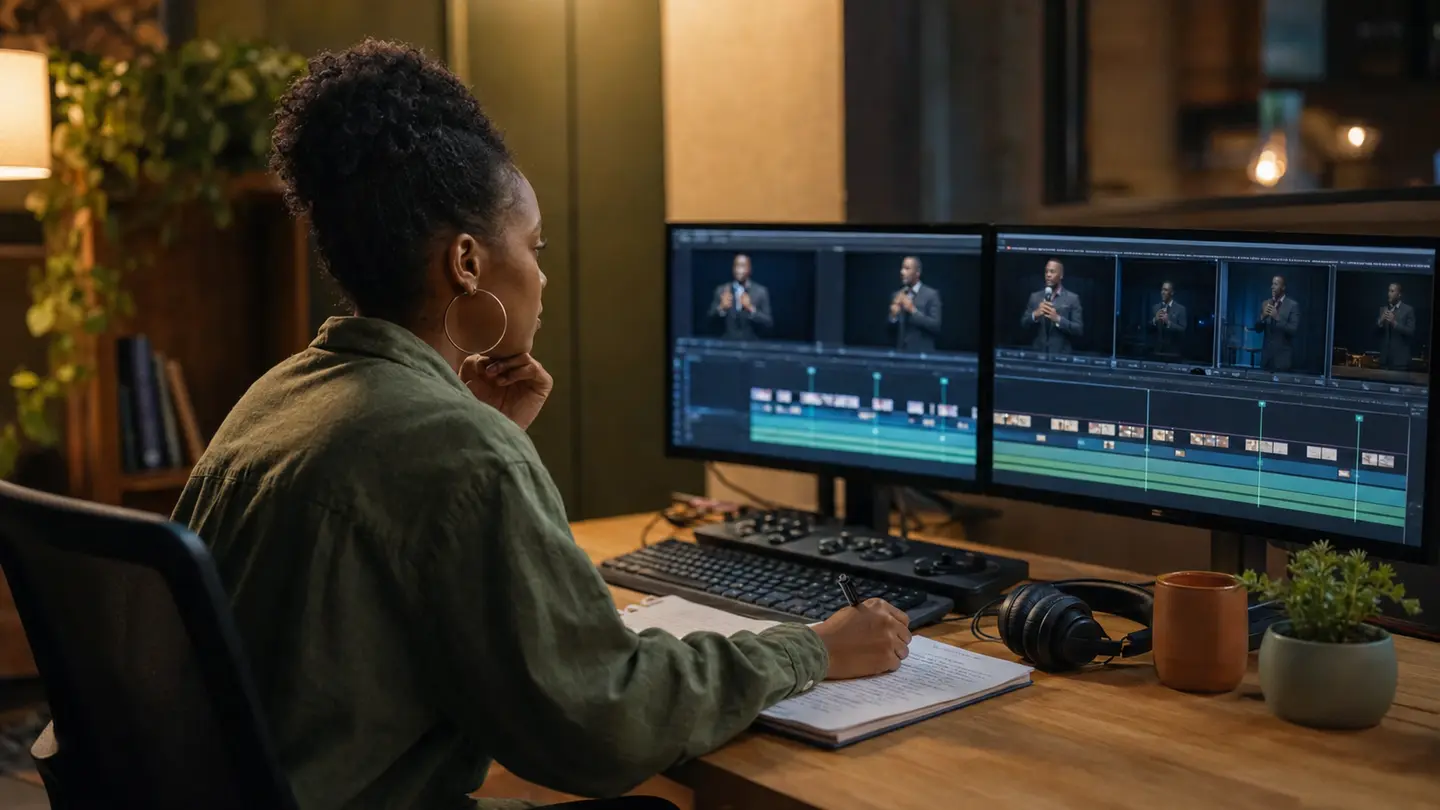
Strong sermon clips are built around complete thoughts, audience fit, truthful hooks, natural boundaries, and platform-aware production—not arbitrary duration.
The 30-second sermon clip has become a superstition.
Sometimes a complete idea lasts 24 seconds. Sometimes it needs 52. The audience does not reward a clip for obeying a number; they reward it for making sense, earning attention, and arriving somewhere worth reaching.
If your short-form workflow begins by forcing every sermon into a duration, it is solving the export problem before the editorial problem.
Start with the outcome, not “viral”
A testimony, teaching explanation, invitation, and reflective prayer should not be ranked by the same philosophy.
Choose what the clip is meant to do:
- Reach someone unfamiliar with the church
- Encourage members
- Explain scripture
- Create discussion
- Preserve a reflective moment
- Tell a coherent story
- Promote a series or initiative
The outcome changes what “best” means. A slow, clarifying explanation may be more valuable to a teaching audience than an emotional sentence that attracts a broad but confused view.
Find the thought before the boundary
Read or listen to the candidate in context. Identify:
-
The setup
-
The central tension or question
-
The claim or turn
-
The resolution
A clip does not need every sermon component, but it needs enough structure to stand independently.
Watch for dangling starts:
- “And that is the reason…”
- “But he did not…”
- “This changes everything…”
- “So when we do that…”
Each phrase points backward. Include the antecedent or choose a cleaner entry.
Watch for false endings too. Applause, a pause, or a strong sentence may feel like a conclusion while the pastor immediately adds the qualification that makes the claim responsible.
Compare more than one cut
For the same underlying moment, create alternatives:
- Tight: the shortest complete form
- Contextual: includes enough setup for a newcomer
- Full thought: preserves the complete rhetorical movement
- Quote-led: centers the memorable line
- Story-led: begins earlier so the human scene carries the idea
Preview them without captions or visual effects. If the passage itself is weak, production will only make the weakness more polished.
Repair boundaries with evidence
Good boundaries use more than sentence punctuation. Spoken language contains breath, silence, overlap, speaker turns, and incomplete grammar.
Vessel can use word timestamps, silence, cadence, and semantic completion to suggest a repair. The editor should still listen for:
- A clipped first consonant
- A breath that belongs to the previous thought
- Audience laughter that needs its setup
- A question separated from its answer
- A pronoun separated from its subject
- A final word cut before room tone settles
Do not hide a poor ending with an automatic fade. Fix the boundary first.
Use hooks that tell the truth
“Watch this” and “You won’t believe…” make almost any sermon feel generic. The best hook often already exists in the speaker’s words.
Choose from:
- A cold open using the strongest faithful line
- A short context card
- A tension-led question grounded in the message
- A clearly identified paraphrase
- A scripture-led introduction
- No added hook
The hook must not promise a conclusion the clip does not deliver. It should help the right audience enter, not trick the largest audience into staying for two seconds.
Production follows editorial approval
Only after approving the moment should you choose:
- Aspect ratio
- Speaker tracking or static crop
- Caption style
- Hook treatment
- Title and attribution
- Brand assets
- Music or sound treatment
Inspect the source video before applying a center crop. A pastor who walks across a stage needs speaker tracking. A two-person testimony may need a wider composition. A screen containing important scripture may need preservation rather than aggressive portrait framing.
Captions should follow speech
Evenly dividing words across the clip duration creates captions that feel detached from the speaker.
Use actual word timing. Group by phrase and punctuation. Limit reading speed and line length. Emphasize spoken stress only when it improves understanding.
Then review the video with sound off. A viewer should be able to follow the thought without reading a flickering stream of isolated words.
Review for fidelity
Store the exact excerpt alongside any social wording. If a hook or quote was refined, identify the transformation. Check whether qualifying language was removed.
This matters because a short clip naturally removes context. The editorial process must prevent compression from becoming distortion.
Judge the clip by its promise
After publishing, record watch time, completion, saves, shares, comments, and meaningful next actions. Compare clips with similar outcomes. Do not conclude that reflective teaching “failed” because it did not behave like entertainment.
The product promise should be simple: find the part people need to hear, prove why it matters, preserve what the pastor meant, and finish it for the place it will be watched.
Sometimes that takes 30 seconds. The number should be the result of the thought—not its prison.
Was this a useful next step?
Take the idea into the workspace.
Keep this guide nearby. Start small, review the result, and make it your own.
Try it in Vessel